Department of Civil and Environmental Engineering · HKUST

Innovative structural components and energy-dissipation devices

Digital twin-aided testing, scan-to-model FE modelling, innovative damping devices, and seismic performance assessment of structural components and systems.

Seismic PerformanceDigital TwinEnergy Dissipation
← Back to all projects
Innovative structural components and energy-dissipation devices
Computer vision and 3D point cloud-aided structural testing

Computer vision and 3D point cloud-aided structural testing

Overview

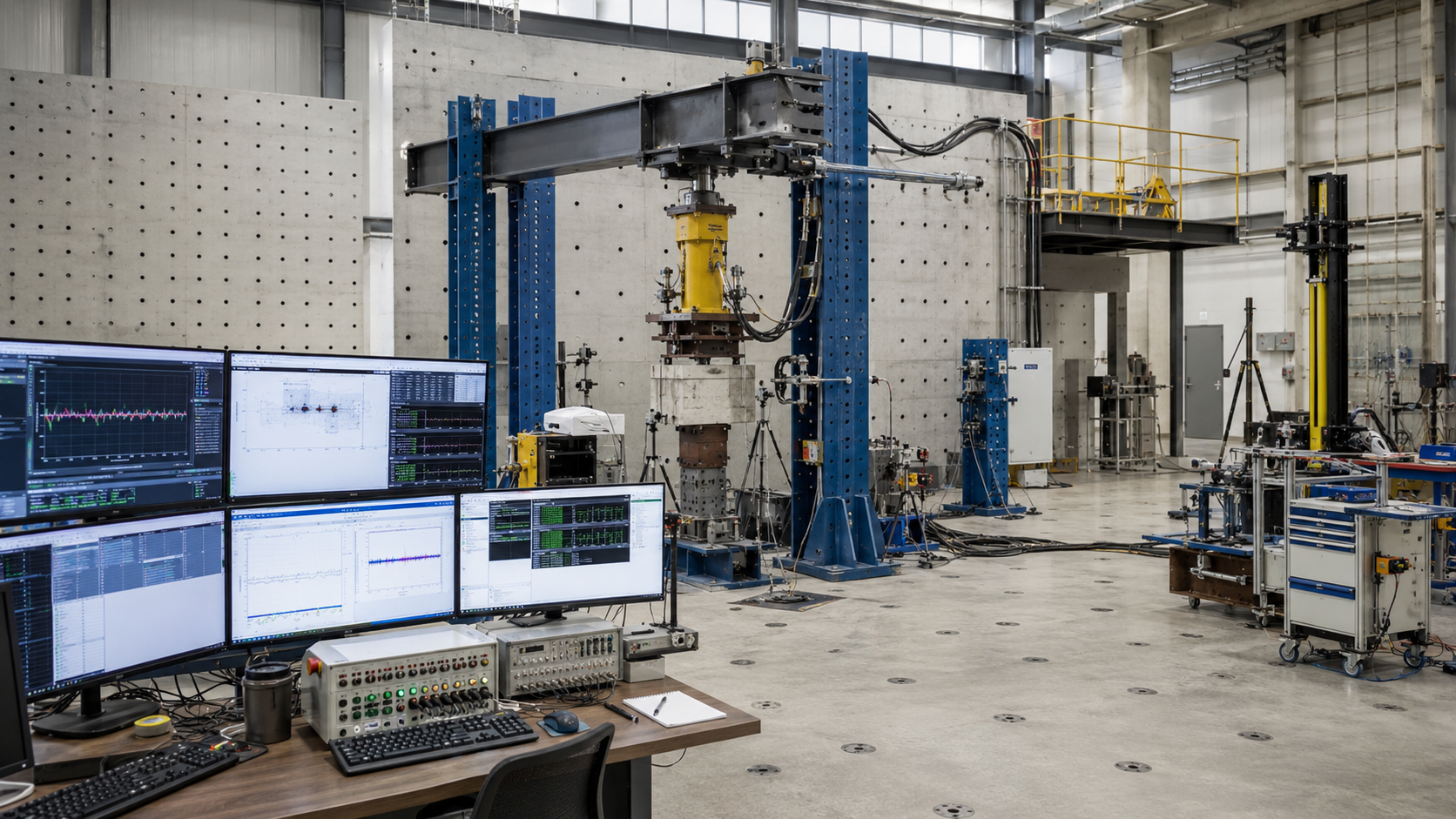
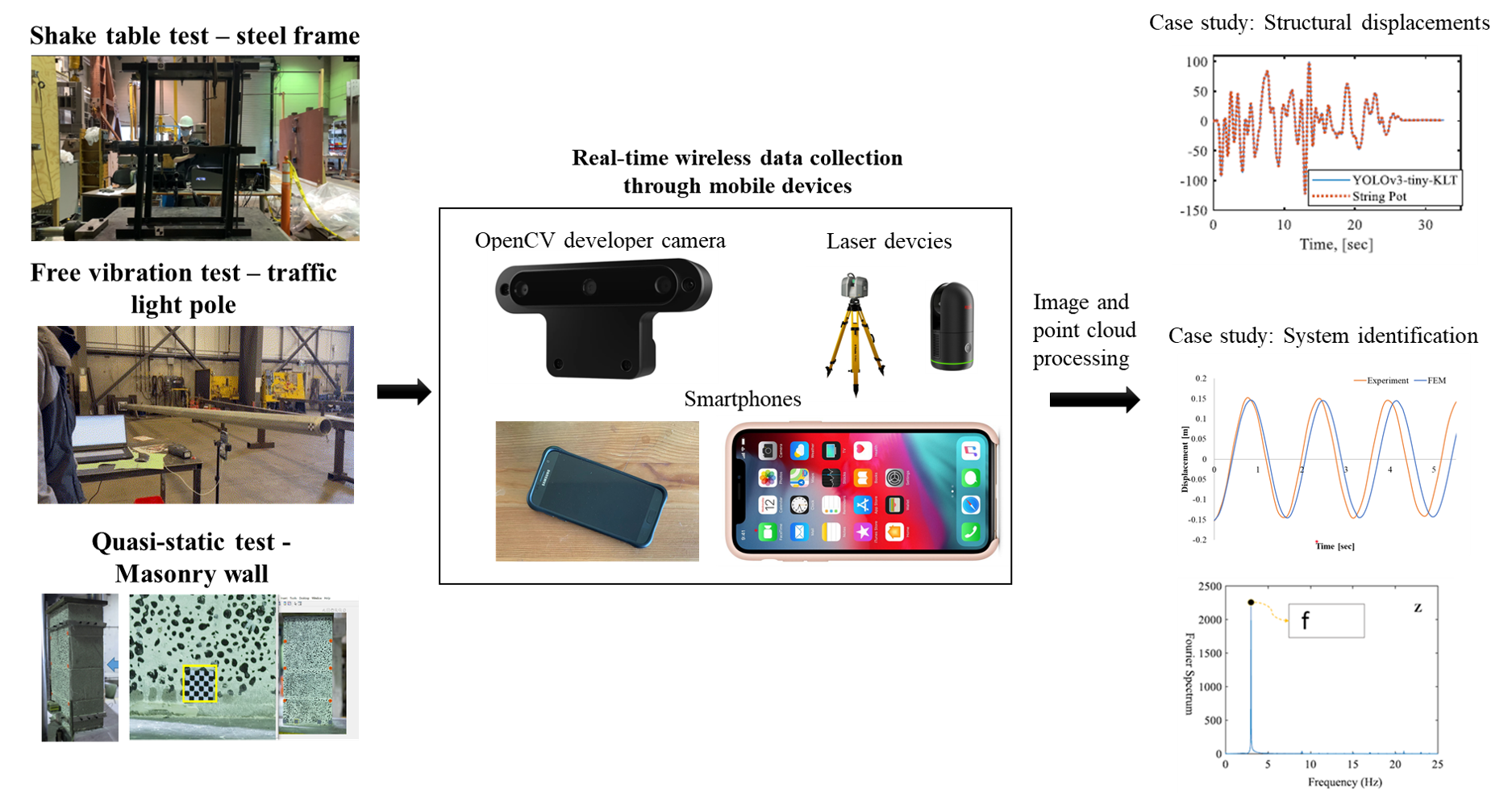
Structural experimental testing is the critical method to evaluate new design concepts. Measuring structural response quantities such as displacements, velocities, accelerations, strain, etc., is crucial to understanding the structural behavior. Traditional contact-type sensors such as string pots and LVDT require a relatively complex instrumentation process and can be inconvenient to use in inaccessible and hard-to-reach areas. This research intends to develop and apply a digital twin approach to measure the structural response quantities in a non-contact and wireless manner. The proposed methodology integrates advanced deep learning, computer vision, point clouds, and smart mobile devices to provide an effective and convenient sensing solution for structural testing.

References

  1. Pan, X., Xiao, Y., Yao, H., Yang, T. Y. (2023). Vision-based real-time structural vibration measurement through interactive deep-learning-based detection and tracking methods. Engineering Structures, 281, 115676.
  2. Chen Z., Xiao Y., Pan, X., Yang T. Y., Yang W. (2023). Vision-aided nonlinear control framework for shake table tests. Canadian Conference - Pacific Conference on Earthquake Engineering (CCEE-PCEE) 2023, Vancouver, British Columbia, Canada.
Computer vision and 3D point cloud-aided finite element modelling

Computer vision and 3D point cloud-aided finite element modelling

Overview

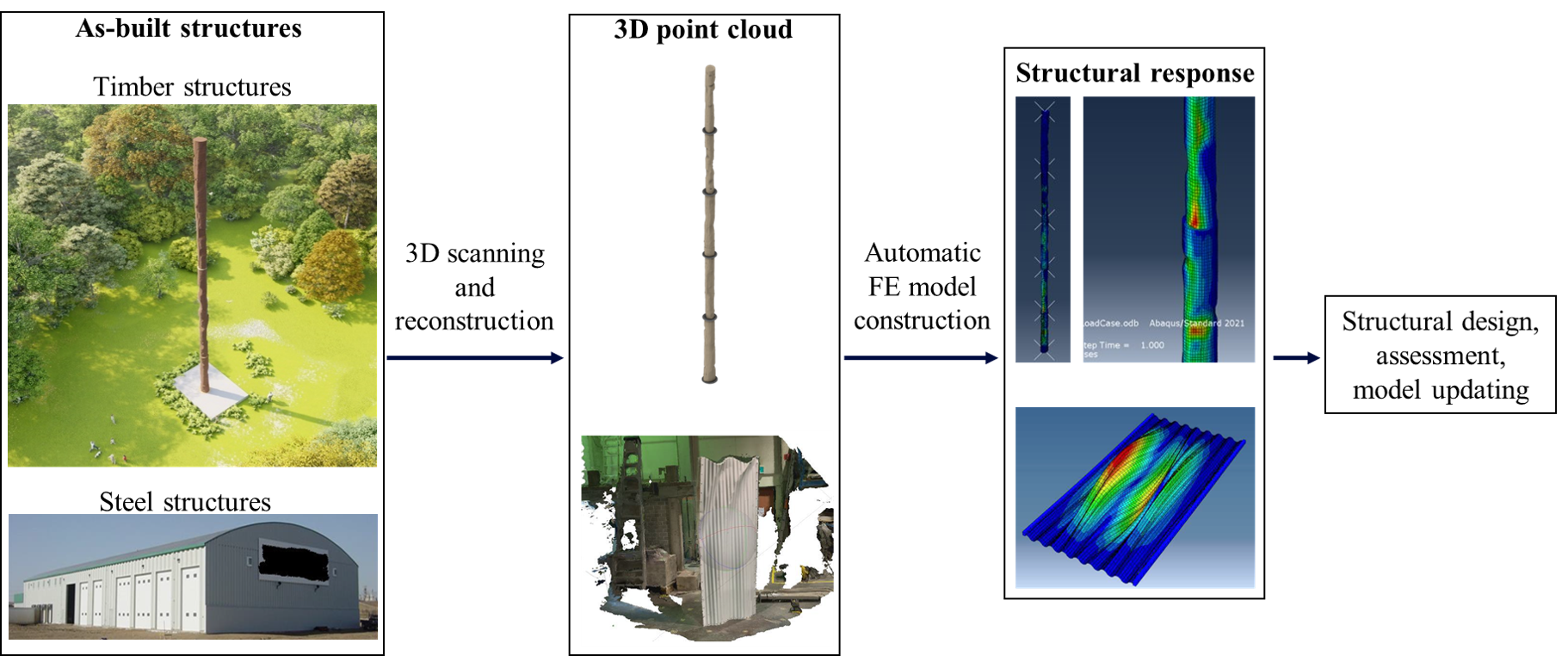
Finite element (FE) modeling is an essential technique to evaluate the structural response. In this project, a scan-to-model framework is proposed, which consists of automatic 3D scanning and reconstruction, point cloud processing, and mesh construction for efficient and accurate FE modeling. The proposed framework can be used to enhance the existing workflow in structural design, performance assessment, and model updating based on the as-built geometry.

References

  1. Xie, F., Pan, X., Yang, T. Y., Ernewein, B., Li, M., Robinson, D. (2024). A computer vision and point cloud processing-based approach for seismic assessment of a tall irregular timber structure. Structures.
Innovative energy-dissipation devices: tuned mass inerter damper

Innovative energy-dissipation devices: tuned mass inerter damper

Overview

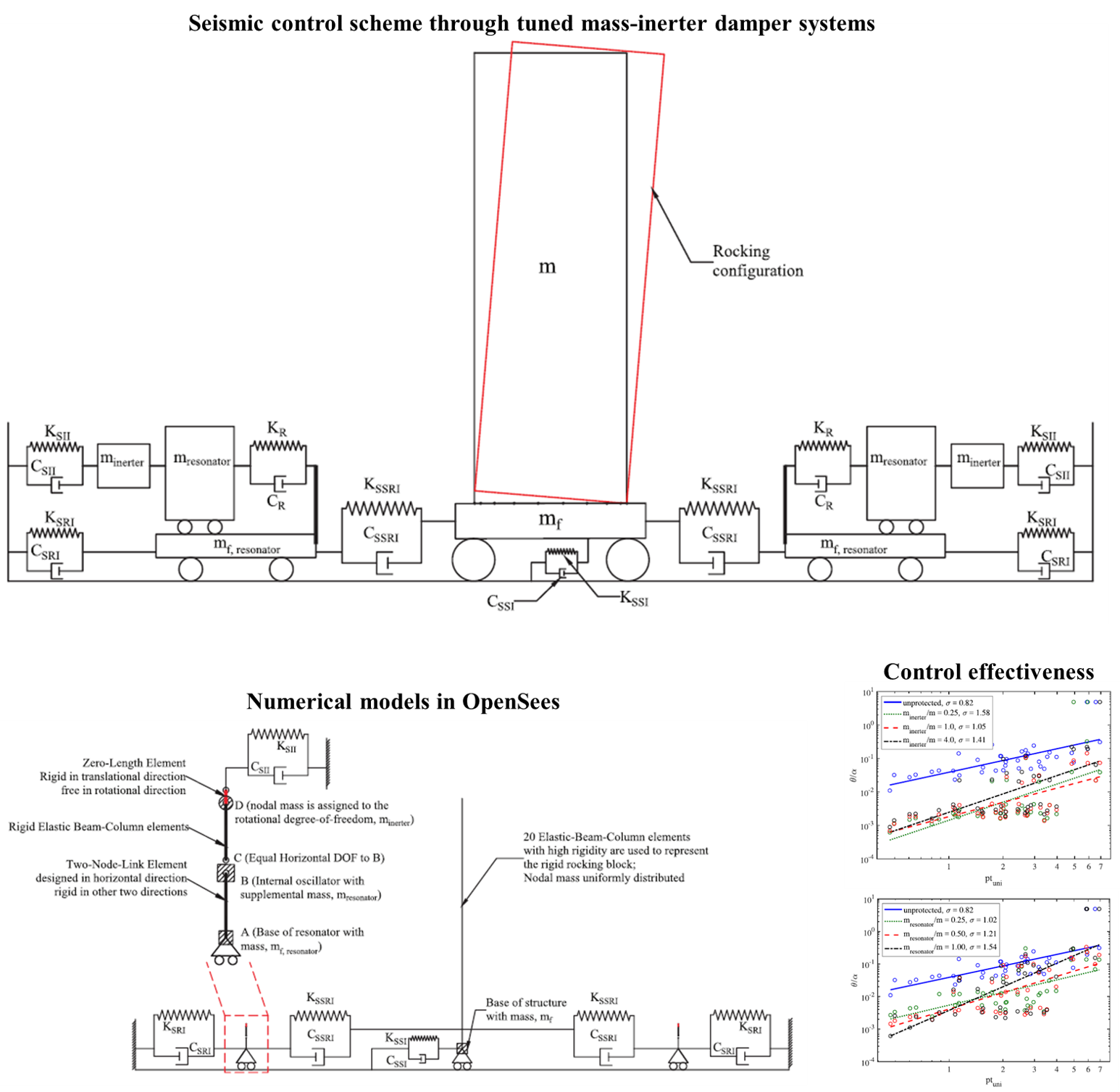
In recent years, inerter systems have been adopted for vibration control of civil structures. This project proposed and extensively investigated a tuned mass inerter damper for vibration control of rigid structures that exhibit rocking behavior when subjected to ground excitations. The results revealed that with proper parameter design, the proposed damping system can effectively reduce the vibration amplitude of rocking structures under earthquake excitations.

References

  1. Pan, X., Málaga-Chuquitaype C. (2020). Seismic control of rocking structures via external resonators. Earthquake Engineering & Structural Dynamics, 49:1180-1196. (Top Cited Article, Top Downloaded Article)